
CIBMTR Reporting Implementation Guide
0.1.12 - Trial Use 1
CIBMTR Reporting Implementation Guide
0.1.12 - Trial Use 1
This page is part of the CIBMTR Reporting Implementation Guide (v0.1.12: Release) based on FHIR (HL7® FHIR® Standard) R4. This is the current published version. For a full list of available versions, see the Directory of published versions
CIBMTR Patient Profile (us-core)
The CIBMTR Patient Profile (us-core) inherits from the US Core Patient Profile, which in turn inherits from the base FHIR Patient resource. This profile meets the requirements of the U.S. Core Data for Interoperability (USCDI) Patient Demographics/Information Data Class and sets minimum expectations for representing, searching, and retrieving patient demographic and administrative information for CIBMTR use cases. It specifies which elements, extensions, and identifier slices SHALL be present and constrains how they are used to support interoperability across CIBMTR reporting workflows.
The following data elements must always be present (Mandatory) or must be supported if the data is present in the sending system (Must Support). They are presented below in a simple human-readable explanation. Profile-specific guidance and examples are provided below.
Each Patient "Must Have"
Each Patient "Must Support"
Additional USCDI Requirements (for certification testing) These elements are not Mandatory or Must Support, but are included in the formal definition of the US Core Patient profile and examples:
Security label requirement (Patient.meta.security)
The CIBMTR Patient profile requires a meta.security label identifying the Transplant Center context (e.g., rc_<CCN>). This security tag is used as part of the query pattern for searching and for access scoping.
Race and Ethnicity (US Core complex extensions)
Ancestry (cIBMTR complex extensions)
Date of Death
Patient.deceasedDateTime (systems SHALL support at least this element if supporting deceased[x]).Previous name / previous address
Patient.name.use = "old" and/or an end date in Patient.name.periodPatient.address.use = "old" and/or an end date in Patient.address.periodInterpreter needed and preferred language
Patient.communication.preferred.Patient Address
SSN caution
Patient.identifier.value) due to identity theft and filtering concerns.A FHIR Patient resource with an identifier containing the CRID must exist on the CIBMTR FHIR server to be used as a subject reference in Observation or other resources. To prevent multiple identical Patient resources from being created, the client must first check to see if it already exists.
To search for Patient resource with a specific CRID, use this GET request (all one line)
GET <base URL>/r4/Patient?
    _security=http://cibmtr.org/codesystem/transplant-center|rc_<CCN>
    &identifier=http://cibmtr.org/identifier/CRID|<CRID>
If the response shows a searchset result with a total of 0, then a Patient resource with that CRID has not been created, and a new Patient resource must be created. In this case, proceed to Submit Patient FHIR Resource.
If the response shows a total of one or more, then at least one Patient with that CRID already exists. In this case, skip Step 3, and go on to Step 4. If more than one Patient was found, then it suggests that someone created a Patient without checking to see if it first exists.
A note about special characters: The FHIR search parameters sometime include special characters such as the pipe character ("|"). Often, these need to be replaced with url-encoded character strings. In this case, "|" is replaced by "%7C" in the values for the keys.
The response below shows one Patient resource, and that resource has an id of 46986.
 |
|---|
| Figure 5: Example of response of Patient search |
The 'id' should be used in all subject.references for all subsequent Observations that are submitted for this Patient. This would have the form of:
"subject": {
    "reference": "Patient/<id>"
    }
Replace <id> with the Patient.id found in the search.
To drive home the point, the
Patient.id is a local server id, and is used as a subject.reference in other FHIR resources.Patient.identifier is a business identifier and the where the CRID is located.If the Patient FHIR resource doesn't already exist, it must be created before any other FHIR resources. The Patient FHIR resource ID is part of the response to the Patient POST request. The resource ID is unique to the CIBMTR FHIR server and is used to reference the Patient subject on all subsequently submitted FHIR resources. The resource ID is assigned by the FHIR server and is different from the Patient.identifier section of the FHIR resource. The Patient ID is NOT a Patient CRID.
The Direct FHIR Service API uses a POST request to submit a Patient resource at the following case-sensitive endpoint URLs:
POST <base URL>/r4/Patient
The authorization key and bearer token must be included in the request as mentioned in the previous section. FHIR JSON submissions should also include a content-type key in the header with value: application/fhir+json.
The Patient FHIR resource usually contains the demographics data for the patient, however, since the demographics data is already submitted during the CRID registration process, there are only three primary components necessary in the Patient FHIR resource:
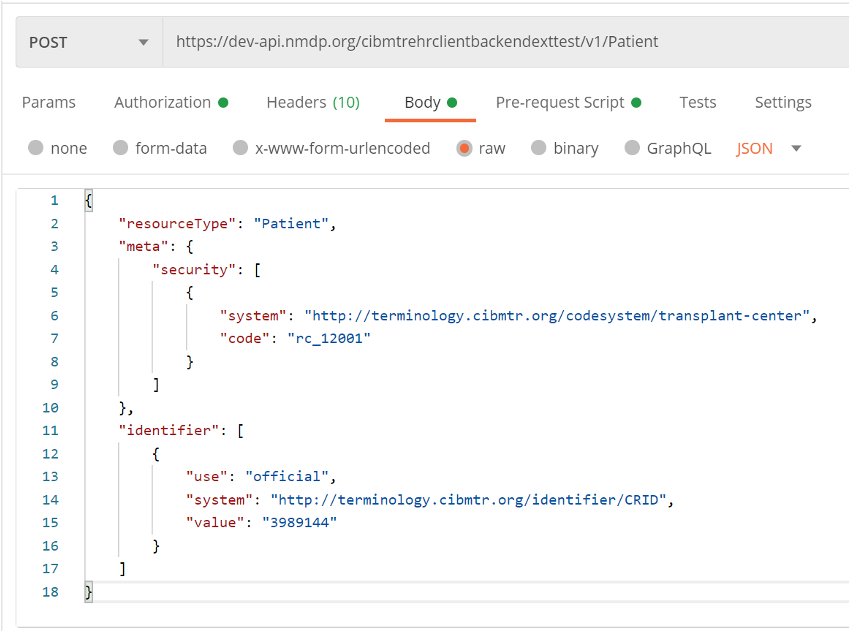
security label (describe above) within the meta section of the Patient resource must contain the CIBMTR Center Number (CCN) prepended with rc_ and associated with the codesystem as shown in Figure 6.text.status section that should have the narrative code of empty if no text narrative is provided. An example is shown in Figure 6.identifier section of the Patient resource as shown in Figure 6.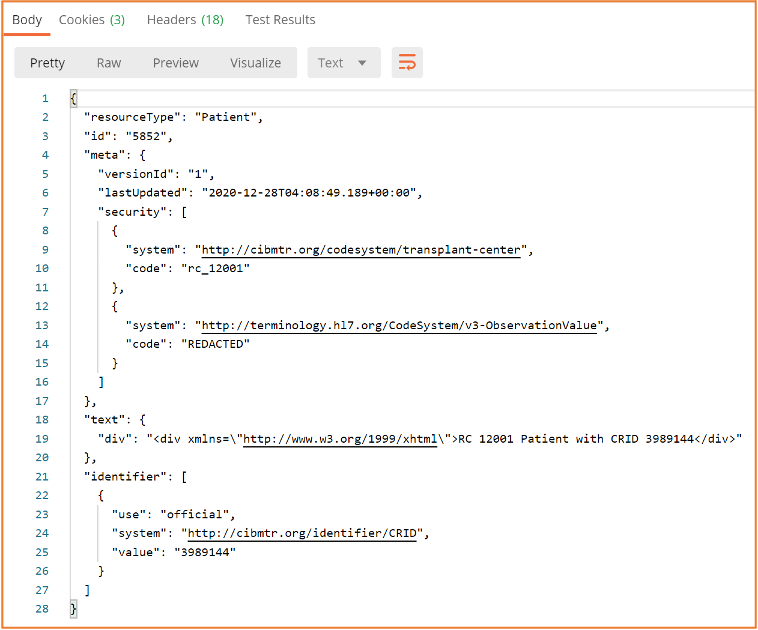 |
|---|
| Figure 6: Example POST request to submit a Patient FHIR resource and the required FHIR sections in the body of the request |
PII information should be avoided as part of the Patient resource. However, the Direct FHIR service API will remove PII information, including any that might be contained in text.div or other sections of the resource before storing it on the FHIR server.
The response after submitting a Patient resource request, includes the Patient resource ID in the header of the response (see Figure 7). The Location section of the response header includes a URL reference for the Patient resource on the CIBMTR FHIR server and the Patient resource ID is in the URL (circled in red in Figure 7). The Patient resource ID is necessary for submitting other FHIR resources to the Direct FHIR service API, but if the ID for a Patient resource previously submitted is not known, the following GET request can be submitted to the API to retrieve the Patient resource for a given CRID:
 |
|---|
| Figure 7: Example FHIR Patient submission response with the Patient resource ID found in the response header Location |
Preferred Patient resource While including the CRID identifier, meta.security tag, and empty text element is the bare minimum for creating a Patient resource, we prefer to have some additional data present to help with resource management. These include date of birth, gender, and race & ethnicity information. Race and ethnicity must be reported as described in the FHIR US-Core Implementation Guide:
https://www.hl7.org/fhir/us/core/StructureDefinition-us-core-race.htmlhttps://www.hl7.org/fhir/us/core/StructureDefinition-us-core-ethnicity.htmlSee the following for an example that using these elements with data as found for registering for the CRID above.
{
    "resourceType": "Patient",
    "meta": {"security": [
        {
            "system": "http://cibmtr.org/codesystem/transplant-center",
            "code": "rc_12002"
        }
    ]},
    "text": {"status": "empty"},
    "identifier": [
        {
            "use": "official",
            "system": "http://cibmtr.org/identifier/CRID",
            "value": "4598886"
        }
    ],
    "gender": "male",
    "birthDate": "1925-07-04",
    "extension": [
        {
            "extension": [
                {
                    "url": "ombCategory",
                    "valueCoding": {
                        "system": "urn:oid:2.16.840.1.113883.6.238",
                        "code": "2106-3",
                        "display": "White"
                    }
                },
                {
                    "url": "text",
                    "valueString": "White"
                }
            ],
            "url": "http://hl7.org/fhir/us/core/StructureDefinition/us-core-race"
        }
    ]
}
Note that ethnicity is not included in the above example. This is because valueset for the US-Core Ethnicity Extension does not include Unknown which was submitted to the CRID service. To be conformant to the FHIR US-Core Implementation Guide, it must be either "Hispanic or Latino" or "Non Hispanic or Latino." Please contact us if you have any questions on how to implement these extensions.
Here's an example with ethnicity included:
{
    "resourceType": "Patient",
    "meta": {"security": [
        {
            "system": "http://cibmtr.org/codesystem/transplant-center",
            "code": "rc_12002"
        }
    ]},
    "text": {"status": "empty"},
    "identifier": [
        {
            "use": "official",
            "system": "http://cibmtr.org/identifier/CRID",
            "value": "4598886"
        }
    ],
    "gender": "male",
    "birthDate": "1925-07-04",
    "extension": [
        {
            "extension": [
                {
                    "url": "ombCategory",
                    "valueCoding": {
                        "system": "urn:oid:2.16.840.1.113883.6.238",
                        "code": "2106-3",
                        "display": "White"
                    }
                },
                {
                    "url": "text",
                    "valueString": "White"
                }
            ],
            "url": "http://hl7.org/fhir/us/core/StructureDefinition/us-core-race"
        },
        {
            "extension": [
                {
                    "url": "ombCategory",
                    "valueCoding": {
                        "system": "urn:oid:2.16.840.1.113883.6.238",
                        "code": "2135-2",
                        "display": "Hispanic or Latino"
                    }
                },
                {
                    "url": "detailed",
                    "valueCoding": {
                        "system": "urn:oid:2.16.840.1.113883.6.238",
                        "code": "2184-0",
                        "display": "Dominican"
                    }
                },
                {
                    "url": "text",
                    "valueString": "Hispanic or Latino"
                }
            ],
            "url": "http://hl7.org/fhir/us/core/StructureDefinition/us-core-ethnicity"
        }
    ]
}